
Graduate Student Recruitment 
US Citizenship or Permanent Residence Required
Three Dimensionally Pixellated Semiconductor Scintillator
 Research Project Funded by DHS (DNDO) and NSF
2007 - 2012

Serge Luryi (PI-PD)
Michael Gouzman, Alexander Kastalsky, Nadia Lifshitz, Milutin Stanacevic, Arsen Subashiev (co-PIs)

We would like to recruit three highly motivated PhD students with background in EE, Physics and similar disciplines to participate in our new spectacular research program, the development of Three-Dimensionally Pixellated Semiconductor Scintillator for homeland security applications. The project is funded by the Department of Homeland Security [Domestic Nuclear Detection Office (DBDO)] and the National Science Foundation (NSF). Detailed description of the project can be downloaded as a PDF file by clicking here.

US Citizenship and/or Permanent Residency is required. All three students will be involved in every aspect of the project, but have the following primary specialization:

GS1 will be primarily involved in circuits and electronics;
GS2 will be primarily involved in semiconductor device fabrication & physical characterization;
GS3 will be primarily involved in theoretical study of detection statistics in semiconductors.

Motivation. Our country in a constant state of alert to terrorist threats.  The prospect of  “dirty bombs” being launched against the United States continues to loom.  The detection of nuclear radiation, therefore, is inextricably linked to our country’s national security. The key issue of interest to these applications is not the sensitivity of a radiation detector, but its ability to discriminate between different nuclear materials.  Otherwise, the apprehension of nuclear terrorists will be bogged down in false alarms.  We have proposed an exciting new approach based on principles of modern opto-electronics, such as those that underlie the operation of all semiconductor lasers. The semiconductor is essentially rendered transparent to its own scintillating radiation in response to incident x- or gamma-rays.   This enables three dimensional resolution of the radiation detector response, which in turn yields the identifying signature (energy and direction) of the incident ray. Three-dimensional (3D) integration of semiconductor scintillator pixels is the most innovative feature of the proposed research.

Relevance to nuclear threat detection. Proposed research goes to the heart of the homeland security needs in DNDO applications, where accurate spectral characterization is of the essence to avoid “false alarms”. The integrated device, functionally a 3D scintillator array of linear dimensions limited only by the size of a semiconductor wafer, will have the energy resolution similar to best semiconductor diodes. It will enable both high-quality isotope discrimination and rapid determination of the direction to source.
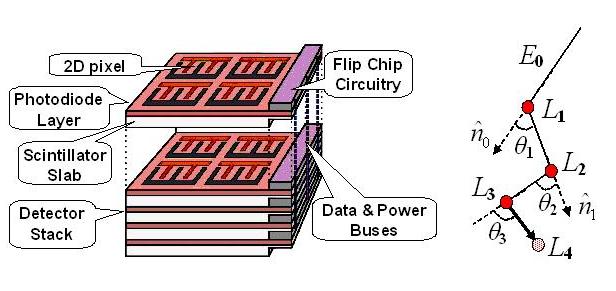

3D scintillator

We shall be building a nuclear radiation detector  comprising 3D integrated scintillator slabs, each provided with a pixellated epitaxial photosensitive layer on its surface. A stack of such detector slabs can accommodate virtually any absorption length of high-energy radiation, without any loss in scintillator yield and speed of response. The information about each ionizing radiation event, comprising simultaneous response from several 3D pixels, is converted to digital form, suitable for rapid analysis. The 3D pixellation of the response enables a novel scheme for high-resolution angular discrimination. The angular information resides in the directionality of Compton scattering cross-section.  It is only owing to the 3D pixellation that this information can be extracted. At the same time, the simultaneous signal registration by several pixels in the stack allows a direct measurement of the incident photon energy, free from complications associated with Compton escape processes. 

Download a more detailed description of the project as a PDF file

See also viewgraphs for Stony Brook's Dept of Physics colloquium, April 2007