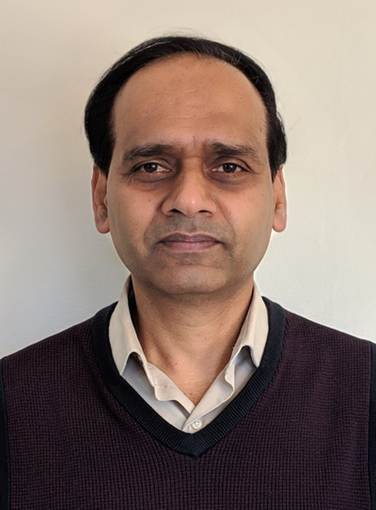
Prof. Muralidhara
(murali) Subbarao, Ph.D.
Professor
Department of
Electrical and Computer Engineering
Stony Brook University
State University of New York
Stony Brook, NY 11794-2350, USA
Phone: (631) 632-8405
E-mail:
murali.subbarao at stonybrook.edu
Research Areas
Computer
Vision
Digital Image Processing
Medical Imaging
Research Assistantships: At this time,
no paid Research Assistantship positions are available.
COURSES
ESE 358 COMPUTER VISION
ESE 568 COMPUTER and ROBOT VISION
ESE457
Fundamentals of DIGITAL IMAGE
PROCESSING
ESE558 DIGITAL IMAGE
PROCESSING
ESE
440 Senior Design I, ESE 441 Senior Design II,
ESE 599 Graduate Research
PUBLICATIONS LIST: See Google
Scholar webpage
Muralidhara
Subbarao - Google Scholar
PATENTS ON 3D MEDICAL IMAGING :
See USPTO
database for full list of Patents, and Patent Applications
- M. Subbarao, Method and Apparatus for High-Sensitivity
Single-Photon Emission Computed Tomography, US Patent No. 8008625, Date
08/30/2011 [Download
PDF format file].
- M. Subbarao, Field Image Tomography for Magnetic
Resonance Imaging, US Patent No. 8,378,682 B2, Date 02/19/2013 [Download PDF format
file].
- M. Subbarao, "Methods and Apparatuses for 3D
Magnetic Density Imaging and Magnetic Resonance Imaging", US Patent
No. 8,456,164 B2, Date 06/04/2013. [Download PDF
format file].
Ph.D. Dissertations Supervised
1.
Dr. Lu, Ming-Chin
2. Dr. Choi, TaeSun
3. Dr. Wei, Tse-Chung
4. Dr. Surya, Gopal
5. Dr. Tyan, Jenn-Kwei
6. Dr. Liu, Yen-Fu
7. Dr. Yuan, Ta
8. Dr. Lin, Huei-Yung
9. Dr. Soon-Yong Park
10. Dr. Tao
Xian
11. Dr. Xue
Tu
12. Dr. Youn-Sik Kang
13. Dr. Shekhar Sastry
Dr. Muralidhara
(Murali) Subbarao is a Professor of
Electrical and Computer Engineering at
His research interests
are Computer Vision, Digital Image/Signal/Video Processing, 3D Medical Imaging,
Integral Equations, Partial Differential Equations, Artificial Intelligence,
Machine Learning, Neural Networks, and related areas.
He is the inventor of
several techniques in Computer Vision, Digital Image Processing, and 3D medical
imaging. He invented the Depth-from-Defocus technique that uses arbitrarily
defocused images (without requirement of any focused image) for
three-dimensional shape recovery. He is also the inventor of Field-Image
Tomography applied to MRI and SPECT imaging. In 1991, he invented the
S-Transform for spatial-domain convolution and deconvolution of images and
signals for shift-invariant kernels or point-spread functions. In 2005, he
extended the S-Transform and invented the Rao Transform (renamed Ram Transform
in 2026) for forward and inverse filtering of images and signals with
shift-variant kernels. This Ram Transform (RT) provided closed-form analytic
solutions in the spatial-domain to shift-variant kernels for forward and
inverse filtering. This RT was also applicable to solving linear integral
equations and partial differential equations. He extended this RT in 2005 to
solve non-linear integral equations through General Rao Transform (renamed
General Ram Transform or GRT in 2026). In the period Dec. 2025 to May 2026,
assisted by AI tools, through intuition, insight, and thoughtfulness, he extended
RT and GRT in numerous ways and invented dozens of mathematical tools and
techniques for signal/image/video processing, solving integral and partial
differential equations, Physics-Informed Neural Nets (PINN), etc. See integralresearch.net for more
information on these inventions. In particular, Ram
Partial Differential Operator (RPDO) and Ram Master Transform (RMT) together
provide a unified framework that is a generalization of over a dozen other
transforms like Fourier Transform, Laplace Transform, Mellin Transform, Wavelet
Transforms, Ram Complex Spectral Transform, etc. These transforms were
generalized to deal with N-dimensional complex, quaternionic, octonionic, and Adelean
domains to make them useful in theoretical physics. Further extension of the
Ram Transforms theory, algorithms, techniques, and tools, are in progress
including topics on Kalman Filter, Particle Filter, Navier-Stokes Equation in fluid-dynamics,
Ram Master Neural Nets, Graph Local Ram Neural Nets, Bayes Nets, Bayes Neural
Nets, etc. See integralresearch.net
for recent updates on these topics.
Prof. Subbarao obtained
a B. Tech. degree in Electrical Engineering from the Indian Institute of
Technology,
In 2026, assisted by AI
tools, he has published over 100 technical reports and filed over 35
provisional patent applications related to the theory and applications of the
Ram Transform family of transforms, techniques, tools, and their extensions. See
integralresearch.net for details.